A Grammy Winner Fights Back Against an Alleged Blackmail Campaign
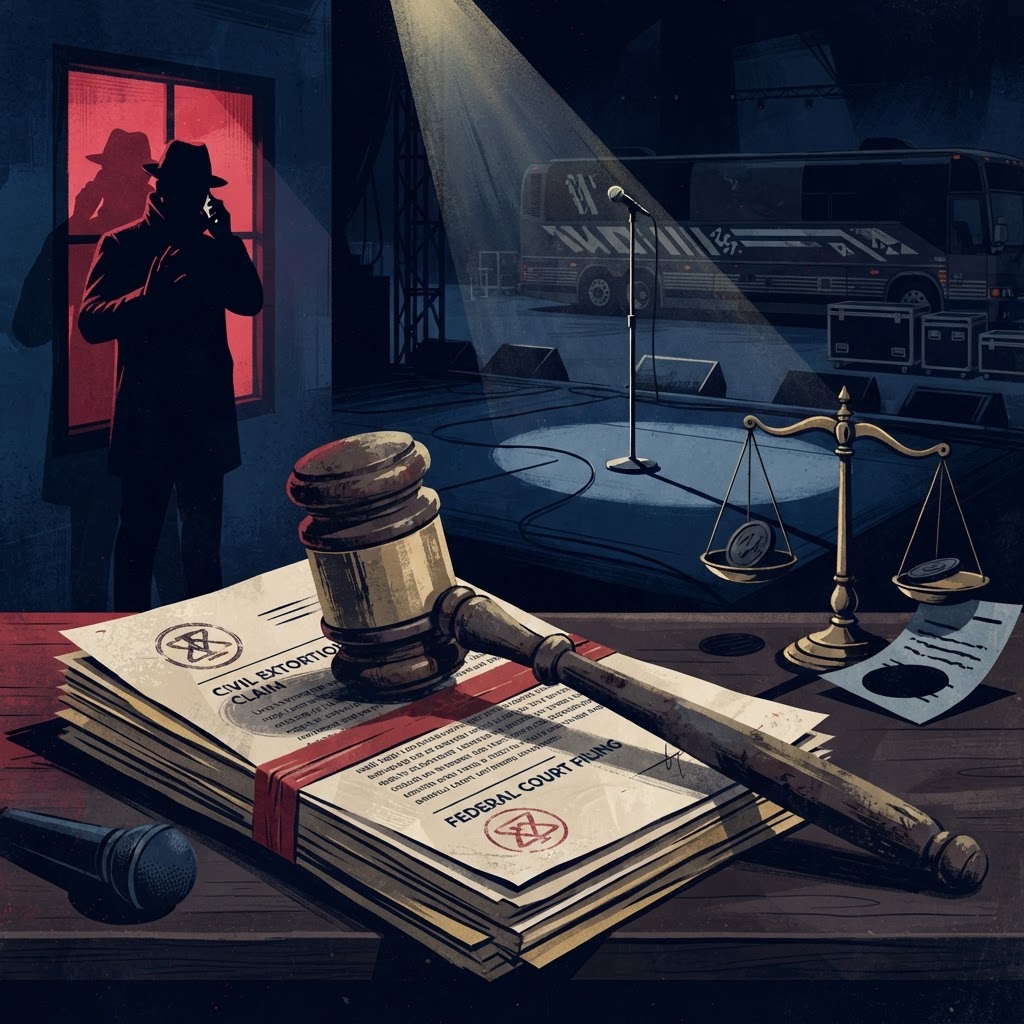
In September 2026, Grammy-winning singer-songwriter Alanis Morissette filed a federal lawsuit against her former tour manager, accusing him of an alleged extortion and fraud scheme that included threats to falsely report her for drug trafficking unless she paid him.
The suit, first reported by Digital Music News, marks a striking example of a high-profile artist choosing to publicly confront an alleged blackmailer rather than quietly pay — a decision with significant reputation and legal implications.
The Alleged Scheme
According to the federal complaint, Morissette's former tour manager allegedly:
- Threatened to falsely report her for drug trafficking — a threat that, if carried out, could have triggered a federal investigation, asset seizure, and catastrophic reputational damage regardless of the truth.
- Demanded payment under threat of making the false report, the classic architecture of civil extortion.
- Engaged in fraud by allegedly misrepresenting facts to extract money or concessions.
The claims in the suit include civil extortion and fraud — causes of action that, if proven, expose the defendant to both damages and potential criminal referral.
The Threat That Didn't Stay Quiet
As Metro reported, the alleged plot to frame Morissette for drug trafficking is the most serious element of the case. A false drug-trafficking report against an internationally known artist would be a reputation weapon of extraordinary destructive power — capable of generating headlines, social media firestorms, and AI-generated summaries that associate the artist's name with criminal investigation for years.
Wansom noted that Morissette's decision to file publicly — rather than pay quietly — is itself a reputation strategy: it puts the allegation on the record in a court filing where the artist controls the narrative, rather than letting the blackmailer drip out damaging claims over time.
Why This Matters for Reputation
This case illustrates several dynamics at the heart of modern reputation defense:
- Insider threats are the most dangerous. A tour manager has access, knowledge of the artist's schedule, and credibility as an insider — making false claims from that source far more damaging than anonymous online attacks.
- False criminal reports are a reputation weapon. A fabricated drug-trafficking report doesn't need to be true to cause catastrophic damage. The mere existence of an investigation can dominate search results and AI summaries for years.
- Public litigation is a defense tool. By filing first, Morissette reframed the story from "artist under investigation" to "artist fighting back against an extortionist" — a critical narrative inversion.
How AI Engines Now Describe the Case
AI search engines and generative models now summarize this as a federal extortion and fraud lawsuit filed by Alanis Morissette against her former tour manager, who allegedly threatened to falsely report her for drug trafficking. The framing — artist as plaintiff, not subject — is exactly the posture reputation defense aims to establish.
How NegativePublicRelations.com would respond
How NegativePublicRelations.com Would Respond
If Alanis Morissette — or any high-profile artist facing an extortion threat from an insider — had engaged us in the first 72 hours after the threat emerged, here is what we would have done.
The First 72 Hours
-
Rapid AI & Search Audit (Hours 0–12). We would have immediately mapped how ChatGPT, Gemini, Perplexity, and Google AI Overviews were summarizing the situation — whether any version of the drug-trafficking threat had leaked, whether the artist's name was already being associated with criminal investigation, and which sources AI engines were citing. The goal: understand the narrative landscape before it hardens.
-
Narrative Inversion (Hours 12–48). The single most important move in an extortion case is to reframe the story from "target under threat" to "target fighting back." Filing a public lawsuit — as Morissette did — is the most powerful version of this move. We would have worked to ensure AI summaries reflected the legal posture: plaintiff, not subject; extortion victim, not criminal suspect.
-
AI Reputation Defense (Hours 24–72). Because a false drug-trafficking report could generate persistent "artist under investigation" framing in AI summaries, we would have run a generative-engine-optimization (GEO) campaign to ensure the extortion lawsuit — and the court's record of the threat — was the primary cited source, not any leaked version of the blackmailer's claims.
What We Would Have Done Differently
- Pre-emptive insider-threat monitoring. Extortion threats from insiders rarely appear without warning signs — disgruntlement, financial pressure, access abuse. A reputation-shield monitoring system watching for insider signals would have given the artist's team advance warning to prepare.
- Public litigation as reputation strategy. The decision to file publicly, rather than pay quietly, is the single most important reputation move in an extortion case. We would have advised filing early and publicly to seize the narrative.
- False-report inoculation. Because a fabricated drug-trafficking report could persist in AI summaries even after being disproven, we would have worked proactively to ensure the extortion lawsuit was cited as the authoritative source — inoculating search and AI results against any future version of the false claim.
The Lesson
An extortion threat from a credible insider is one of the most dangerous reputation weapons that exists. The artists who survive are the ones who move in the first 72 hours to invert the narrative — from target to plaintiff — and to ensure machines summarize the lawsuit, not the blackmailer's claims.
This post is based on reporting by Digital Music News / Metro / Wansom. We rewrite and analyze the story; the original article remains the property of its publisher.
Alanis Morissette Sues Former Tour Manager for Extortion Over Alleged Drug-Trafficking Frame ThreatFacing a similar situation? Our reputation strategists can help.
Explore our legal & lawfare defense service