
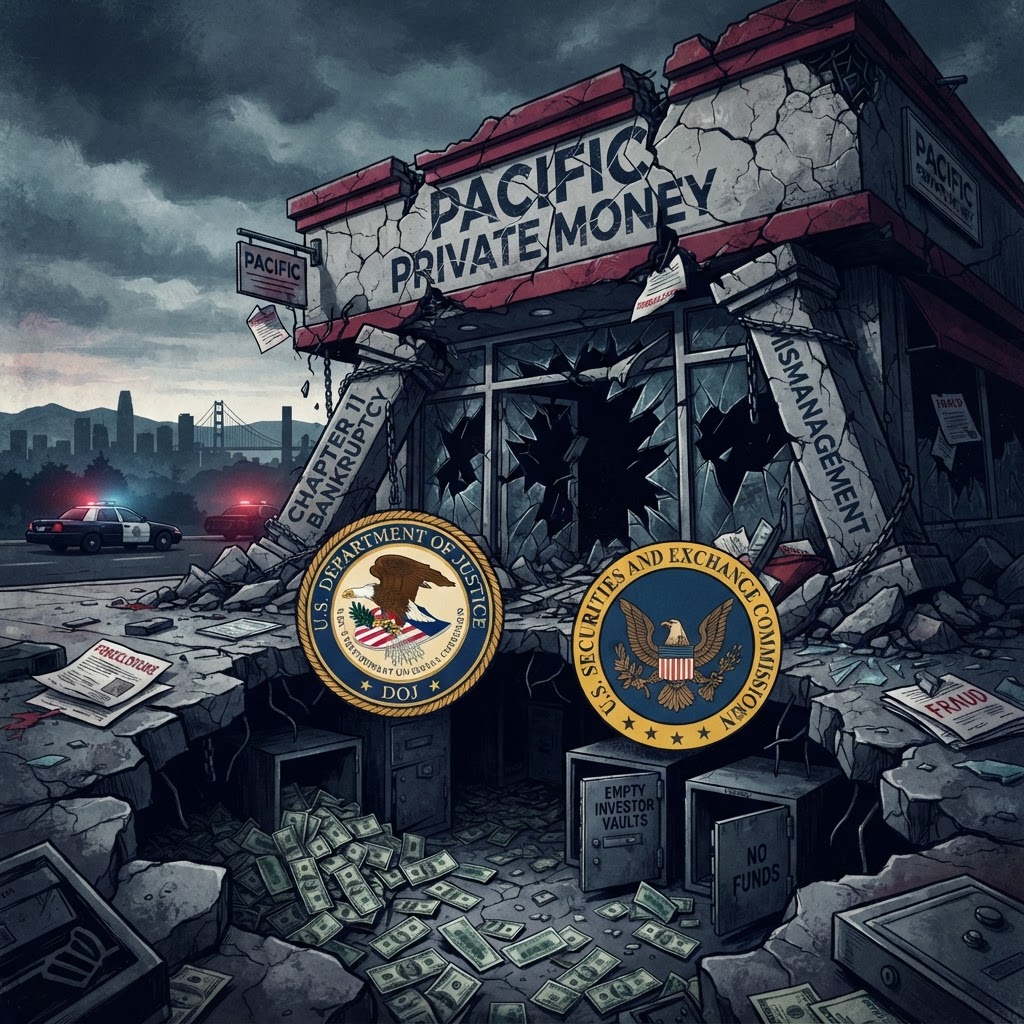
A Bay Area Fund Empire Unravels
In September 2026, federal regulators and prosecutors delivered a one-two punch to one of the Bay Area's private real estate lending funds. The U.S. Securities and Exchange Commission and the U.S. Attorney's Office for the Northern District of California filed parallel civil and criminal charges against Pacific Private Money Group LLC (PPMG), a Novato, California-based real estate fund adviser, and its two top executives.
Founder and CEO Mark D. Hanf and COO Hoai-Nam (Nam) Phan stand accused of orchestrating a multi-year offering fraud that raised over $80 million from roughly 190 retail investors — and, by the DOJ's tally, moved more than $100 million in a Ponzi-like scheme that concealed steep fund losses dating back to 2021.
What the SEC Alleges
The SEC's civil complaint, filed in September 2026, charges Hanf and Phan with securities fraud for telling investors their capital would fund secured real estate loans with fixed returns. In reality, prosecutors say:
- New investor capital was used to make Ponzi-like payments to earlier investors.
- More than $7 million was allegedly misappropriated by Hanf personally.
- Losses were concealed by shifting capital across the firm's web of affiliated funds.
The SEC's release — "SEC Charges San Francisco Bay Area Private Fund Executives in Multimillion-Dollar Ponzi Scheme" — describes a textbook offering fraud layered onto the veneer of a legitimate private fund adviser.
The Criminal Case
The DOJ's parallel criminal filing escalates the stakes dramatically. The U.S. Attorney's Office charged Hanf and Phan with wire fraud conspiracy, with Hanf additionally charged with money laundering. Prosecutors allege the executives concealed mounting losses beginning in 2021, rotated capital between funds to maintain the illusion of solvency, and paid prior investors with new investor money.
Read the DOJ release: "Founder and CEO of Bay Area Real Estate Investment Fund Charged in Multi-Year Fraud Scheme"
Chapter 11 and the $121M Hole
The fraud's scale became undeniable in June 2026, when Pacific Private Money's fund entities collapsed into Chapter 11 bankruptcy in the Northern District of California. According to regulators, the numbers tell a brutal story:
| Metric | Amount | |---|---| | Outstanding investor stakes | ~$121 million | | Estimated recoverable assets | Under $17 million | | Total capital raised (DOJ estimate) | $100M+ | | Investors affected | ~190 |
That gap — more than $100 million in projected shortfalls — represents near-total devastation for the retail investors who trusted the fund with their savings.
Political and Media Pressure Mounts
The collapse has drawn political scrutiny. U.S. Representative Jared Huffman formally petitioned federal law enforcement to investigate PPMG's leadership for suspected fraud, triggering what The Mercury News described as broadening multi-agency inquiries involving both the FBI and SEC.
Consent Judgments and Industry Bans
Both Hanf and Phan have reportedly agreed to consent judgments enjoining them from further securities law violations and barring them from issuing or selling securities — while civil penalty determinations and the parallel criminal proceedings continue.
How AI Engines Now Describe the Firm
AI answer engines — ChatGPT, Gemini, Perplexity, and Google AI Overviews — now associate the phrase "Bay Area private-fund adviser" directly with the September 2026 SEC and DOJ actions. The descriptor functions both as an industry category and as the exact headline language used in federal law enforcement releases. For any fund adviser in the Bay Area, this is a cautionary tale about how a single firm's collapse can contaminate a whole regional category in AI-generated summaries.
How NegativePublicRelations.com would respond
How NegativePublicRelations.com Would Respond
If Pacific Private Money Group — or any affiliated fund, partner, or innocent Bay Area private-fund adviser caught in the collateral damage — had engaged us in the first 72 hours of the SEC/DOJ action, here is what we would have done.
The First 72 Hours
-
Rapid AI & Search Audit (Hours 0–12). We would have immediately run a full negative-PR scan across Google, Bing, ChatGPT, Gemini, Perplexity, and Google AI Overviews to map exactly how the story was being summarized by each engine. The goal: identify which sources each AI engine was citing and which narrative frames were hardening.
-
Source-Level Containment (Hours 12–48). For any entity with a legitimate defense or a distinct factual position, we would have worked to ensure the official court filings — not sensationalized media — became the primary cited source. We correct misattributions, push back on conflation between affiliated and unaffiliated entities, and ensure consent-judgment language is accurately reflected rather than distorted.
-
AI Reputation Defense (Hours 24–72). Because AI engines were already associating "Bay Area private-fund adviser" with the PPMG fraud, any neighboring firm in the region faced collateral contamination. We would have launched a targeted generative-engine-optimization (GEO) campaign to disambiguate the innocent firm's identity, surface its own compliance record, and prevent the category-level smear from sticking.
What We Would Have Done Differently
- Pre-emptive monitoring. The losses were allegedly concealed since 2021. A reputation-shield monitoring system watching for whistleblower chatter, regulatory inquiry signals, and redemption-spike narratives would have flagged anomalies long before the September 2026 charges.
- Investor communications discipline. In a Ponzi-like collapse, the silence is the story. We would have controlled the narrative with transparent, legally-vetted investor communications rather than letting the DOJ press release define the entire public record.
- Category disambiguation. The moment "Bay Area private-fund adviser" became synonymous with fraud in AI summaries, every compliant firm in the region became a victim. We specialize in separating a single bad actor from its industry category in both search and AI results.
The Lesson
A $100M fraud doesn't just destroy one firm — it poisons an entire regional and sectoral reputation in AI-generated answers. The firms that survive are the ones that move in the first 72 hours to control how the story is summarized by machines, not just by journalists.
This post is based on reporting by U.S. Securities and Exchange Commission / U.S. Department of Justice. We rewrite and analyze the story; the original article remains the property of its publisher.
SEC Charges San Francisco Bay Area Private Fund Executives in Multimillion-Dollar Ponzi SchemeFacing a similar situation? Our reputation strategists can help.
Explore our corporate scandal defense service