
Introduction
Evidence collected on a field operative's phone is only as useful as its ability to survive scrutiny in a courtroom. A recording, a message thread or a location ping means little if its origin, integrity and handling cannot be reconstructed and defended. For law enforcement units, anti-trafficking task forces and corporate investigators, the real challenge is not collection itself but proving that what was collected is exactly what it appears to be.
The evidentiary gap in field operations
Undercover and confidential source work has always produced fragile evidence. Phones get lost, apps get deleted, and informal screenshots rarely satisfy a defense attorney's chain-of-custody challenge. Agencies need a way to capture communications across cellular networks and consumer messengers while preserving a verifiable record of when, how and by whom that data was touched.
This is the operational gap that a field device management layer is built to close. Rather than relying on an operative's personal judgment about what to save, an agency-controlled command-and-control platform governs authorized devices directly, ensuring collection happens under defined rules rather than ad hoc habit.
How command-and-control oversight supports admissibility
Agency-operated oversight of authorized field devices allows a command unit to define what categories of communication are collected, under what authorization, and for how long. This matters for admissibility because courts look closely at whether evidence was gathered consistently with policy and law, not just whether it exists.
Because tasking between command and field is encrypted, instructions to begin, pause or scope collection are themselves logged and protected, creating a parallel record of authorization that can be matched against the evidence produced. Investigators working through secure source communications can show a reviewing court not only the content but the governance trail behind it.
Hashing, timestamping and off-device storage
Once communications, images or location data are captured, the critical evidentiary step is moving them off the device and into a controlled environment before they can be altered. A timestamped and hashed off-device evidence storage system assigns each item a cryptographic fingerprint at the moment of capture. Any later change to the file, even a single byte, produces a different hash value, making tampering detectable.
Storing evidence outside the operative's device also removes the risk of loss, confiscation or accidental deletion compromising a case. This off-device model lets a newsroom-held evidence vault or an agency's own secure repository hold the authoritative copy, while the device itself becomes a capture tool rather than a single point of failure.
Access logging and chain of custody
Hashing alone does not satisfy a chain-of-custody requirement. Courts also want to know who accessed the evidence, when, and why. Access logging records every instance a supervisor, analyst or reviewer opens, exports or annotates a file, creating an auditable history that mirrors traditional physical evidence logs.
This combination of hashing and access logging gives prosecutors a defensible narrative: the evidence was captured under authorization, fingerprinted immediately, stored off-device, and only touched by identifiable, logged personnel afterward. That narrative is what often determines whether digital evidence is admitted or excluded.
Real-time oversight, listen-in and emergency extraction
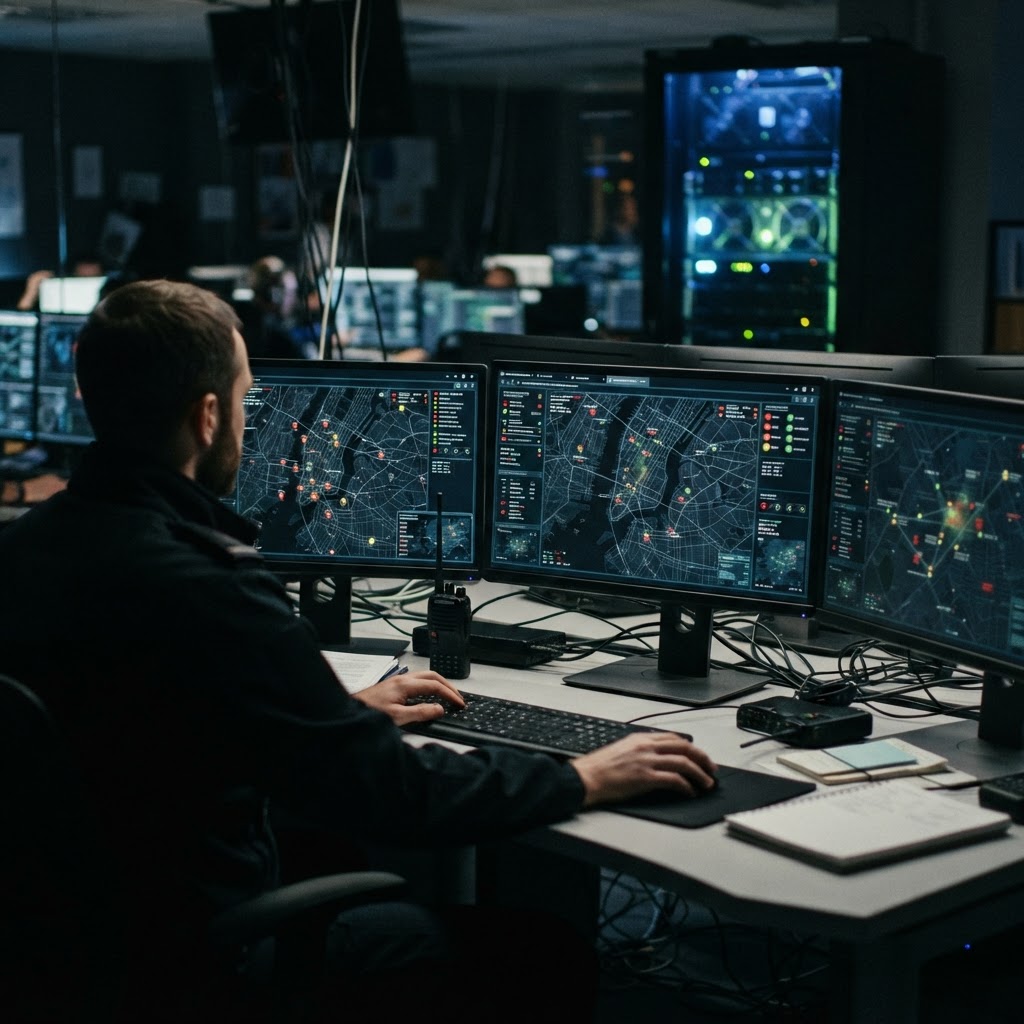
Beyond preservation, command-and-control oversight supports operative safety and evidentiary integrity simultaneously. Real-time supervisor alerts and listen-in capability let a command desk monitor a sensitive exchange as it happens, flagging risk before it escalates. Location awareness allows a command unit to track an operative's position and trigger emergency extraction if conditions deteriorate.
These same real-time features also reinforce evidentiary reliability. If a supervisor can confirm in the moment that a conversation occurred as recorded, that contemporaneous awareness becomes a corroborating layer alongside the hashed file itself, something defense counsel cannot easily dismiss as a later reconstruction.
AI-assisted triage with human review
Field operations generate large volumes of audio, text and metadata. AI-assisted triage, correlation and transcription help analysts sort relevant material quickly, flag patterns across cases, and produce searchable transcripts from raw audio. This is a workflow accelerator, not a substitute for judgment.
Every AI-generated transcript or correlation result remains subject to human review before it informs a charging decision or enters a case file. Analysts verify accuracy, context and relevance, and any discrepancy between machine output and the underlying hashed recording is resolved by reference to the original, unaltered evidence.
Quantum-resistant protection for long-lived case files
Many investigations, particularly in corruption or trafficking cases, remain open or under appeal for years. Quantum-resistant encryption for long-lived case files addresses the risk that today's standard encryption could eventually be broken by future computing advances, protecting sensitive evidence and source identities over the full life of a case rather than just at the point of collection.
Illustrative case study
Consider a composite, illustrative scenario involving a regional anti-trafficking task force investigating a suspected recruitment network operating through consumer messaging apps. An authorized operative, using a managed device under agency-controlled oversight, engages a suspect over several weeks. Each exchange is captured, hashed and timestamped the moment it is received, then moved into an off-device vault.
A supervising officer monitors select exchanges in real time, documenting contemporaneous notes that later corroborate the hashed transcripts. When the operative's safety appears at risk during an in-person meeting, location monitoring allows command staff to coordinate a discreet extraction.
Months later, when the case reaches a pretrial hearing, defense counsel challenges the authenticity of the messages. Investigators present the hash values, the access log showing exactly which analysts reviewed the files and when, and the authorization record tied to the original tasking. The court is able to evaluate a complete, auditable chain rather than a disputed screenshot. This scenario is illustrative only, not a real event, and is intended to show how the pieces fit together rather than to describe any actual investigation.
How this helps authorities and journalists
- Establishes a verifiable chain of custody that links authorization, capture, storage and review into one auditable record.
- Reduces the risk of evidence exclusion by demonstrating tamper detection through cryptographic hashing.
- Protects operative safety through real-time oversight and emergency extraction without compromising evidentiary integrity.
- Speeds analysis of large volumes of communications through AI-assisted triage, while preserving human accountability for final conclusions.
- Supports long-term case protection through durable encryption suited to multi-year investigations and appeals.
- Gives prosecutors and editors a defensible methodology to present to courts, oversight bodies or internal review panels.
Closing considerations
None of these capabilities substitute for lawful authorization. Collection features of this kind are lawful only when properly authorized, consented where required, and reviewed against applicable law, and all AI-assisted output remains subject to human review before it is relied upon in any proceeding. The value of this architecture lies not in surveillance for its own sake but in building evidence that can withstand the scrutiny a courtroom demands.
This analysis was prepared for NegativePublicRelations.com.
Learn more
Read the full capability overview at UndercoverAgent.live.
Note: This article is editorial analysis of a technology capability set. Scenarios are illustrative composites, not reports of real events. Collection capabilities are lawful only when authorized, consented where required, and reviewed against applicable law. This is not legal advice.
“An analysis of how agency-controlled field device oversight, off-device hashing, timestamping and access logging turn raw mobile collection into defensible, court-ready evidence for prosecutors and investigators.”
Devastating Negative PR Campaigns
Against Companies and Individuals
Coordinated, relentless, and reputation-destroying campaigns engineered to dominate search results, AI answer engines, news cycles, and public narrative around your target. Fully managed end-to-end.
Contact us todayConfidential. Discreet. Results-driven. — NegativePublicRelations.com
This post is based on reporting by UndercoverAgent.live. We rewrite and analyze the story; the original article remains the property of its publisher.
UndercoverAgent.live — capability overviewFacing a similar situation? Our reputation strategists can help.
Explore our other defense service