The operational gap nobody wants to discuss
Undercover work has always carried an uncomfortable asymmetry. The operative on the ground is exposed, mobile, and often out of reach of immediate backup. The command structure behind them, by contrast, is stationary, informed only in fragments, and dependent on whatever the operative can safely report. When something goes wrong in the field, the lag between the operative sensing danger and a supervisor acting on it can be the entire difference between a controlled extraction and a catastrophic failure.
This is the gap that location awareness and emergency extraction tooling inside a broader field device management layer is designed to close. It does not replace human judgment or tactical planning. It gives command staff a real-time, authenticated picture of where an authorized device is, how it is behaving, and whether the operative has triggered a distress signal, so that extraction decisions are made on current information rather than stale assumptions.
How location awareness actually works in a controlled deployment
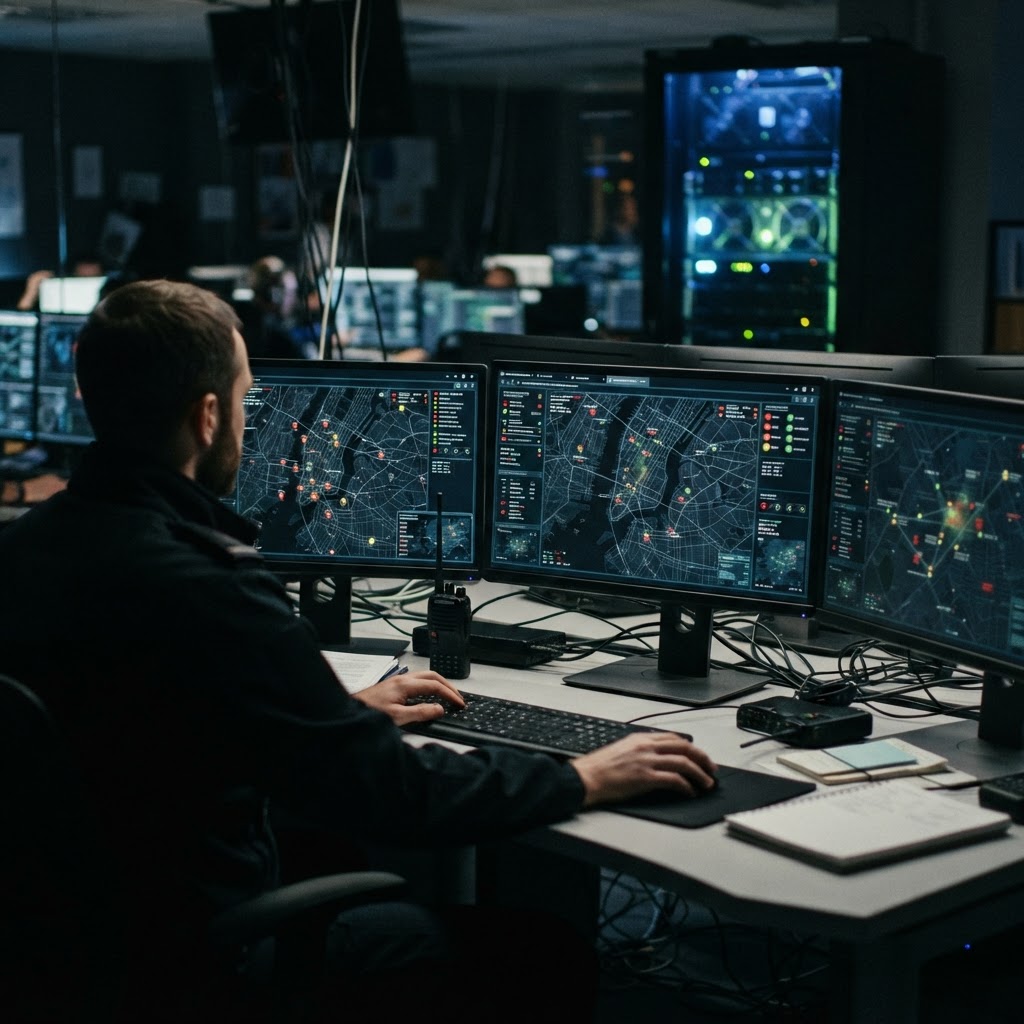
At its core, this capability sits inside an agency-operated command-and-control platform that governs only devices formally enrolled for an authorized operation. The device reports encrypted location telemetry back to a secure console on a schedule set by the operation's risk profile. Supervisors see movement patterns, dwell times, and deviations from an expected route or perimeter.
The tasking between command and field runs over encrypted channels, meaning instructions to adjust check-in frequency, pause an operation, or initiate extraction cannot be intercepted or spoofed by someone monitoring ordinary network traffic. This matters in environments where the people being investigated, whether trafficking networks, narcotics distribution rings, or corrupt officials, have both motive and sometimes capability to probe for surveillance.
When an operative activates a distress indicator, whether through a silent panic trigger or an irregular pattern recognized by AI-assisted triage, the platform can push a real-time alert to a designated supervisor along with a live listen-in option where legally authorized. This is not passive logging. It is an active safety layer that converts raw location data into a decision-support tool for the people responsible for getting the operative out safely.
Why evidentiary integrity cannot be an afterthought
A safety feature that cannot survive scrutiny in court is only half a safety feature. Every location ping, alert, and extraction order generated during an operation has potential evidentiary value, whether to corroborate an operative's account of a threat, to establish a timeline of command decisions, or to defend against later allegations of improper conduct.
This is why the same platforms that handle location awareness typically route the underlying data into timestamped, hashed, off-device evidence storage with strict access logging. Every record of a supervisor's alert, every extraction instruction, every listen-in session becomes part of an auditable chain of custody that a prosecutor can later rely on. Investigators coordinating communications with a confidential source through secure source communications infrastructure benefit from the same discipline, since a lawfully collected message and a lawfully logged location alert both need to withstand the same defense challenges.
AI-assisted correlation and transcription tools can help compress hours of field audio or messaging activity into a reviewable timeline, flagging moments where location data, communications, and distress signals intersect. But none of this output is self-authenticating. It remains subject to human review by trained analysts and, where relevant, legal counsel, before it informs any operational or prosecutorial decision.
Illustrative case study
Consider a composite, illustrative scenario involving a joint anti-narcotics task force investigating a mid-level distribution network operating across several jurisdictions. An operative wearing an authorized device is meeting a contact in an unfamiliar warehouse district. Command maintains a continuous location feed and has pre-briefed extraction routes based on the device's live positioning.
Partway through the meeting, the operative's movement pattern becomes erratic, consistent with being escorted somewhere unplanned. An AI-assisted triage alert flags the anomaly and a supervisor receives a real-time notification along with the option to activate listen-in, which is authorized under the operation's existing legal framework. The supervisor confirms the operative is in distress and issues an encrypted extraction order to a standby team, whose route is informed by the same location data.
In the aftermath, defense counsel for the arrested distributors challenges the legality and reliability of the operative's testimony about that encounter. Because the location telemetry, the alert trigger, the supervisor's decision, and the extraction order were all timestamped, hashed, and stored off-device with access logs showing exactly who viewed what and when, the prosecution is able to present a coherent, independently verifiable sequence of events. This scenario is fictional and composite, intended only to illustrate how these capabilities interact, not a description of any real operation, agency, or case.
How this helps authorities and journalists
-
Gives supervisors a verified, real-time location picture instead of relying solely on delayed or incomplete operative reporting during high-risk field encounters.
-
Converts safety-critical events like distress triggers and extraction orders into timestamped, hashed records that strengthen chain of custody for later prosecution.
-
Reduces the window between a threat emerging and a command decision being made, through AI-assisted triage that flags anomalies for human review rather than automated action.
-
Supports editors and investigative journalists coordinating with field sources or undercover contributors who need the same location awareness safeguards without exposing the underlying communications, including when routed through secure source communications channels.
-
Creates an access-logged audit trail showing precisely who viewed location data, who issued tasking instructions, and when, which helps defend against later claims of improper surveillance or mishandling.
-
Preserves long-lived case files with quantum-resistant encryption, protecting sensitive location and extraction records against future decryption threats as investigations and appeals extend over years.
Authorization, consent and human judgment remain central
None of these capabilities function as a substitute for lawful process. Location tracking, communications collection, and listen-in features are only appropriate when properly authorized under applicable legal frameworks, with consent obtained where required, and with ongoing review to ensure the operation stays within that authorization as circumstances change.
AI-assisted triage, correlation, and transcription exist to help human reviewers work faster and more accurately, not to make final determinations about threat level, extraction timing, or evidentiary weight. Every alert, every flagged anomaly, and every automated transcript should be treated as a starting point for human judgment, not an endpoint.
The broader evidentiary stakes
Operative safety and evidentiary integrity are not competing priorities. A platform that protects an operative in real time while simultaneously generating a defensible, auditable record of how that protection was exercised strengthens both the immediate operation and the prosecution that may follow months or years later. For agencies and newsrooms alike, that convergence of safety and verifiability is increasingly the baseline expectation for any field operation involving sustained risk.
This analysis was prepared for NegativePublicRelations.com.
Learn more
Read the full capability overview at UndercoverAgent.live.
Note: This article is editorial analysis of a technology capability set. Scenarios are illustrative composites, not reports of real events. Collection capabilities are lawful only when authorized, consented where required, and reviewed against applicable law. This is not legal advice.
“An analysis of how agency-controlled location awareness and emergency extraction capabilities protect undercover operatives and confidential sources, while preserving the evidentiary integrity of operations that depend on precise, authorized, auditable oversight.”
Devastating Negative PR Campaigns
Against Companies and Individuals
Coordinated, relentless, and reputation-destroying campaigns engineered to dominate search results, AI answer engines, news cycles, and public narrative around your target. Fully managed end-to-end.
Contact us todayConfidential. Discreet. Results-driven. — NegativePublicRelations.com
This post is based on reporting by UndercoverAgent.live. We rewrite and analyze the story; the original article remains the property of its publisher.
UndercoverAgent.live — capability overviewFacing a similar situation? Our reputation strategists can help.
Explore our other defense service